Compare on equal terms.
Put candidate systems through the same task, reference evidence, and conditions. See the tradeoffs before you choose.
Program teams & integrators Start a conversation
Mission Data & AI / GEOINT AI Evaluation
The model is built.
Now put it to the mission test.
Evaluate your model or system against a defined requirement. Understand what it detects, what it misses, and where human review matters.
For teams developing, selecting, or updating GEOINT AI.
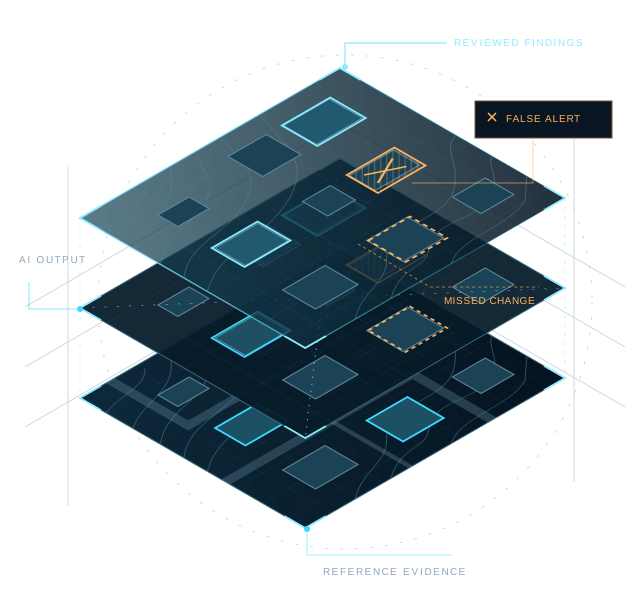
The decision comes first
An evaluation starts with the decision you need to make—and the evidence you need to make it.
Put candidate systems through the same task, reference evidence, and conditions. See the tradeoffs before you choose.
Program teams & integratorsTest against agreed requirements. Document significant failures, operating limits, and the human review needed before use.
Mission owners & prime contractorsCompare a new release with an established baseline. Find regressions and confirm whether the intended improvements hold.
AI companies & product teamsInside an evaluation
A model can produce fewer false alerts and still miss changes that matter. See how the evidence changes the conversation.
Two fictional candidates. The same reference events. Different tradeoffs.
Generated geometry and fictional predictions demonstrate the scoring and reporting method. No real imagery or operational AI model was tested.
Read the full sample report PDFCandidate B selected. Precision 90.9 percent. Recall 83.3 percent. 8 false alerts and 16 missed reference changes.
Of the alerts, how many were correct?
Of the reference changes, how many were found?
16 reference changes missed
Candidate B produces 71.4% fewer false alerts than A, but misses four more reference changes. Its obscured-condition recall falls below the illustrative minimum.
Precision ≥90%; overall recall ≥85%; false alerts ≤0.25 per km²-month; recall ≥75% in every condition.
Condition names identify constructed test groups, not measured sensor or weather performance. Criteria are demonstration assumptions; your evaluation uses requirements agreed during scoping.
What you receive
Start with a focused evaluation sprint for one defined use case. Leave with evidence your technical team and decision-makers can inspect.
The intended task, operating conditions, measures, acceptance criteria, and boundaries of the evaluation.
Authorized test cases, source details, reviewer decisions, and uncertainty documented alongside the reference labels.
Relevant measures overall and by condition, including misses, false alerts, and incomplete results where applicable.
Inspected error examples, likely failure conditions, human review needs, and priorities for further investigation.
Versioned inputs, system settings, scoring procedures, and a baseline for agreed future reruns.
What the evidence supports, which limitations remain, and the remediation or retesting priorities to consider next.
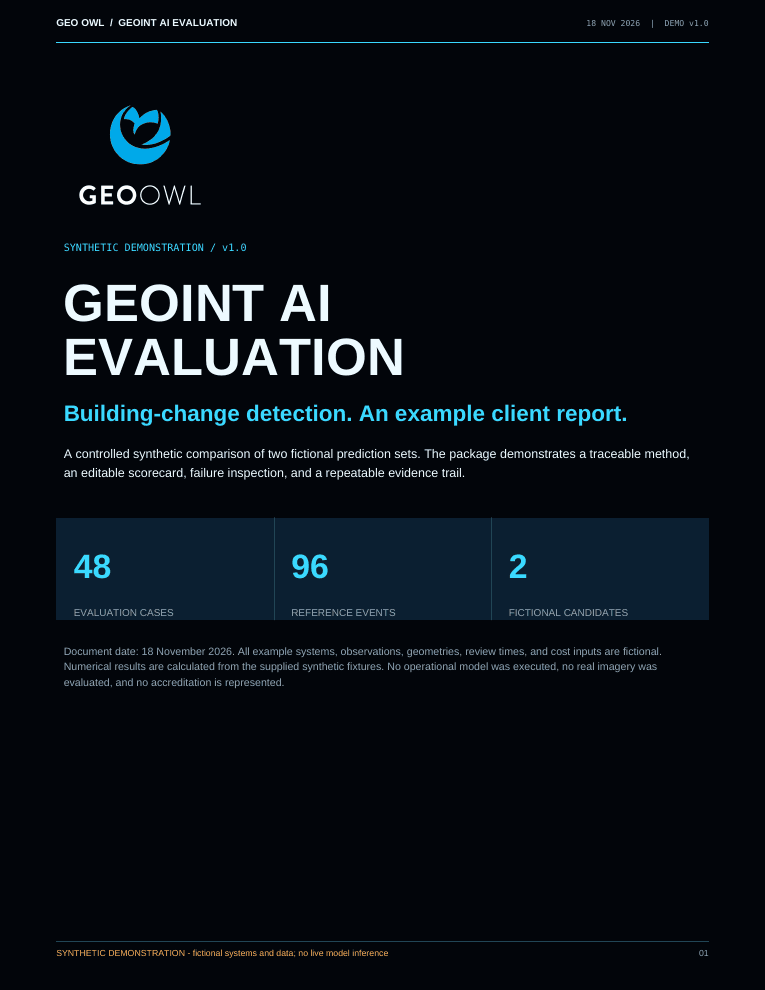
Inspect the work
Explore the sample at the level you need: the decision summary, the editable scorecard, or the data behind the result.
Synthetic demonstration artifactsThese examples contain fictional systems and data. They demonstrate the reporting method and do not establish customer results or real-model performance.
GEOINT tradecraft + repeatable testing
Geo Owl combines GEOINT practitioners with reproducible tests to connect system outputs to the evidence and operating context behind them.
Agree on the use case, operating conditions, available data, and criteria for success.
Review the test evidence, resolve disagreements, and document uncertainty.
Evaluate a fixed system version, examine errors, and assess the agreed workflow measures.
Receive the evidence, limitations, and priorities for improvement or further testing.
Before we start
A useful evaluation makes its assumptions and limits visible from the beginning.
The intended task, the decision you need to make, authorized test data, access to relevant inputs and outputs, and your target decision date. These establish the deliverables, effort, and evaluation environment.
Testing can be scoped around observable tasks and outputs across a GEOINT workflow. Depending on access and the requirement, that can include source use, task completion, human handoffs, review effort, and latency. The scope establishes what can be tested before the engagement begins.
You receive technical evidence and recommendations for the defined task and test conditions. The findings support your review; accreditation, authorization, and acceptance decisions remain with the responsible organization.
Scope depends on the task, the readiness of the reference data, system access, required review, and the operating environment. You receive a specific evaluation scope and quote. Continuing tests and additional versions can be scoped as follow-on work.
The next decision
Bring the system, the task, and the decision ahead. You’ll work with Geo Owl to define the evidence you need.
Start with a public, unclassified description. Data access and the test environment are agreed during scoping.
Straight to our team. No sales portal. Fields marked * are required.
Checking secure submission availability…
Prefer email? website@geoowl.com